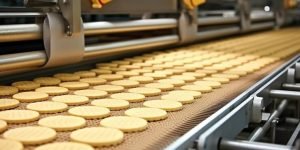
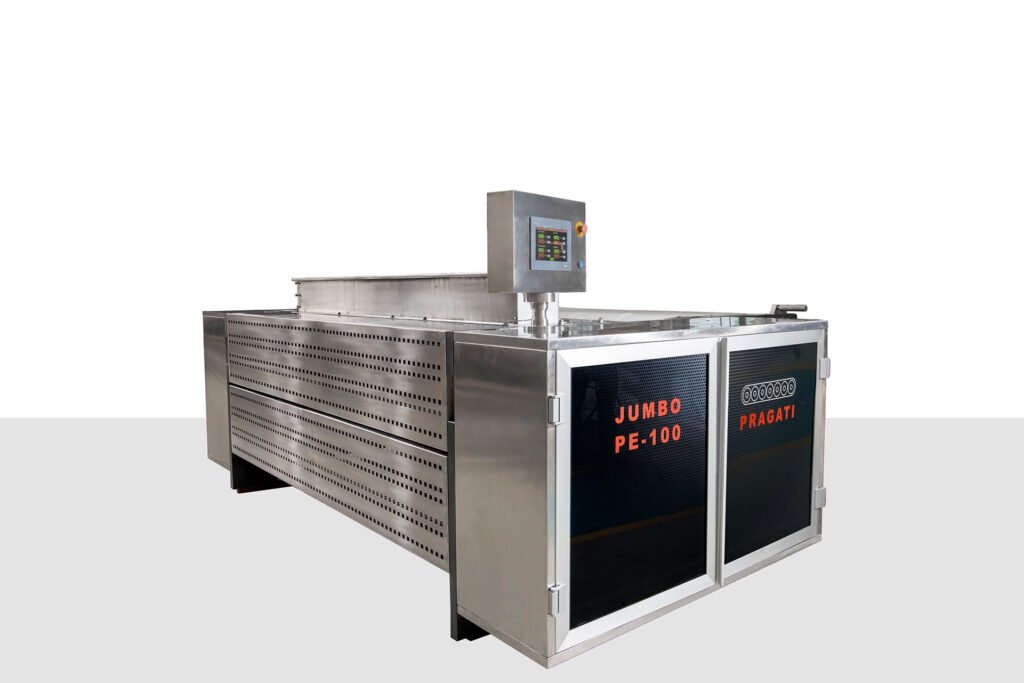
The baking stage is the most critical step in biscuit manufacturing. An industrial biscuit baking system transforms shaped dough into finished products with the right texture, color, and taste.
A hygienic biscuit baking oven ensures consistent baking results while meeting strict food safety standards required for modern food processing facilities.
According to international food processing standards, proper baking requires precise temperature control, uniform heat distribution, and adequate baking time.
Choosing the right industrial biscuit baking system for your production line directly impacts product quality, operational costs, and food safety compliance.
What Is an Industrial Biscuit Baking System and Why Is It Important?
An industrial biscuit baking system is a continuous tunnel oven designed specifically for high-volume biscuit production. Unlike batch ovens, these systems feature multiple temperature zones, continuous conveyor belts, and precise control systems.
A hygienic biscuit baking oven incorporates food-grade materials, easy-clean surfaces, and design features that prevent contamination.
This baking system is essential for:
- Consistent baking results across millions of biscuits
- Uniform color and texture development
- Energy-efficient operation
- Compliance with food safety standards
- High-volume continuous production
A reliable hygienic biscuit baking oven ensures each biscuit receives the same heat exposure, eliminating under-baked or over-baked products.
Key Components of an Industrial Biscuit Baking System
1. Oven Tunnel
The enclosed baking chamber where heat is applied to biscuits.
Material: Stainless steel with rounded corners
Function: Contains heat and prevents energy loss
2. Conveyor Belt
Transports biscuits through all baking zones.
Type: Wire mesh or steel band
Function: Moves biscuits continuously through the oven
3. Heating System
Provides the heat required for baking.
Types: Direct gas fired, indirect gas fired, electric, or hybrid
Function: Generates and transfers heat to biscuits
4. Exhaust System
Removes moisture and baking vapors from the oven chamber.
Material: Stainless steel ducting
Function: Maintains proper humidity levels inside the oven
5. Temperature Control System
Monitors and adjusts temperature in each zone.
Components: Sensors, controllers, and actuators
Function: Maintains precise baking temperatures
6. Insulation
Prevents heat loss from the oven surfaces.
Material: High-density mineral wool
Function: Reduces energy consumption and maintains external surface safety
How Does an Industrial Biscuit Baking System Work?
The working principle of an industrial biscuit baking system combines multiple heat transfer methods.
Step-by-Step Working Process:
1. Dough Loading: Shaped biscuits enter the oven on a continuous wire mesh conveyor belt.
2. Zone 1 – Initial Heating: The first zone rapidly raises dough temperature, activating leavening agents and setting the product structure.
3. Zone 2 – Color Development: The second zone develops golden-brown color through caramelization.
4. Zone 3 – Moisture Reduction: The third zone removes excess moisture to achieve proper crispness.
5. Zone 4 – Final Drying: The final zone equalizes moisture content throughout each biscuit.
6. Cooling Exit: Baked biscuits exit the oven and move to the cooling conveyor.
This continuous process enables manufacturers to produce thousands of perfectly baked biscuits per hour.
How to Choose the Right Industrial Biscuit Baking System
When selecting an industrial biscuit baking system for your production line, consider these factors:
1. Production Volume
Match oven capacity to your line speed requirements.
2. Product Type
Hard dough and soft dough require different baking profiles.
3. Fuel Source
Choose between gas, electric, or hybrid based on utility availability.
4. Hygiene Requirements
Look for hygienic biscuit baking oven with easy-clean design.
5. Energy Efficiency
Check insulation quality and heat recovery options.
6. Supplier Support
Ensure installation, training, and spare parts availability.
Features of a Hygienic Biscuit Baking Oven
A high-quality industrial biscuit baking system offers:
- Multiple temperature zones for precise baking profiles
- Stainless steel construction for corrosion resistance
- Easy-clean design with access doors
- Energy-efficient insulation to reduce fuel consumption
- Variable speed control for different product types
- Uniform heat distribution across belt width
- Automated temperature monitoring and control
Proper temperature control using a hygienic biscuit baking oven ensures consistent biscuit quality across all production batches.
A reliable hygienic biscuit baking oven integrates seamlessly with other equipment to deliver consistent baking results with minimal fuel consumption.
Benefits of an Industrial Biscuit Baking System
Choosing the right industrial biscuit baking system offers:
- Consistent color and texture across all biscuits
- Energy savings (up to 30% with modern insulation)
- Reduced baking time through optimized heat transfer
- Lower maintenance with hygienic design
- Compliance with international food safety standards
- Higher production capacity
A hygienic biscuit baking oven allows manufacturers to meet export quality requirements and pass rigorous food safety audits.
Investing in a modern industrial biscuit baking system enables manufacturers to reduce energy costs while improving product quality.
With the right hygienic biscuit baking oven, businesses can scale operations and maintain consistent quality across millions of biscuits daily.
Industrial Biscuit Baking System: Complete Process Table
| Zone | Temperature Range | Function | Duration |
|---|---|---|---|
| Zone 1 - Initial Heating | 180°C - 220°C | Activates leavening agents, sets structure | 1 - 2 minutes |
| Zone 2 - Color Development | 200°C - 250°C | Develops golden-brown color | 1 - 2 minutes |
| Zone 3 - Moisture Reduction | 160°C - 200°C | Removes excess moisture for crispness | 1 - 3 minutes |
| Zone 4 - Final Drying | 140°C - 180°C | Equalizes moisture content | 1 - 2 minutes |
Applications in Industry
These baking systems are widely used in:
- Large-scale biscuit manufacturing plants
- Cookie and cracker production units
- Cream biscuit and sandwich biscuit lines
- Export-oriented food processing facilities
- Automated industrial bakery systems
These systems are commonly integrated with Die Roll Systems for soft dough or Biscuit Cutters for hard dough lines.
A reliable hygienic biscuit baking oven is essential for any industrial setup aiming for food safety certification and export market access.
Complete Production Line Integration
In modern biscuit manufacturing, an industrial biscuit baking system must work in coordination with forming and cooling equipment to ensure smooth operations.
To build a reliable and efficient production system, you can explore the following solutions:
Industrial Mixers – for uniform dough preparation
Power Dough Feeder – for consistent dough supply
Die Roll System – for soft dough shaping
Direct Gas Fired Oven – for uniform baking
These machines help improve productivity, reduce energy costs, and ensure consistent product quality. A well-integrated industrial biscuit baking system is the foundation of successful biscuit production.
Conclusion
An industrial biscuit baking system and hygienic biscuit baking oven are essential for modern biscuit production. By selecting the right equipment and ensuring proper integration, manufacturers can achieve consistent quality, energy efficiency, and food safety compliance.
For reliable industrial biscuit baking system solutions, working with an experienced supplier ensures long-term performance and technical support for your production line.
Contact a trusted hygienic biscuit baking oven manufacturer today to discuss your specific baking requirements.
Blogs
-
+ 91 9821048088
+91 9967474660 - pragati@pmepltd.com
- R-666, TTC Industrial Area, Rabale ,MIDC, Navi Mumbai -400701