
A rotary cutter has a direct influence on biscuit shape, dimensions, surface pattern and the overall efficiency of a production line. Choosing the wrong configuration can lead to incomplete cuts, uneven products, excessive dough scrap and frequent production interruptions.
However, selecting the right machine involves more than comparing operating speed or cutter width. Biscuit manufacturers must consider the dough, product design, required capacity, upstream equipment, oven configuration and cleaning requirements.
This guide explains how to choose a rotary cutter that fits your current production needs while providing enough flexibility for future products.
What Is a Rotary Cutter in Biscuit Manufacturing?
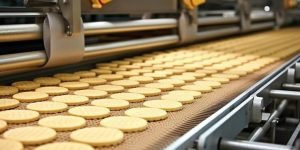
A rotary cutter is a continuous dough-forming machine used to cut biscuits, crackers and similar products from a prepared dough sheet. The dough sheet passes between rotating components that emboss, dock and cut it into the required shape.
Depending on the product and machine configuration, the cutting system may use:
- A cutting roll
- An engraved embossing roll
- A pressure or anvil roll
- Docking pins
- Scrap-separation arrangements
- Product-transfer conveyors
Industrial systems may use engraved rolls to emboss and cut dough pieces from a continuous sheet. Rotary cutting is commonly used for sheeted crackers and hard sweet biscuits, whereas rotary moulding is normally selected for soft-dough products formed inside mould cavities. Baker Perkins
Understanding this distinction is the first step in any reliable rotary cutter selection guide.
Rotary Cutting vs Rotary Moulding
Rotary cutting and rotary moulding are sometimes treated as interchangeable processes, but they perform different functions.
A rotary cutter works with a continuous dough sheet. The sheet is prepared by laminating, sheeting and gauging equipment before entering the cutter. The machine then cuts individual pieces from that sheet.
A rotary moulder feeds soft dough into engraved mould cavities and transfers the formed pieces onto a conveyor. It is typically used for soft-dough biscuits, shortbread and products requiring deeper three-dimensional patterns.
Why Complete Line Compatibility Matters
The rotary cutter cannot correct problems created by an inconsistent dough sheet. If the laminator produces variable thickness or the gauge rolls do not maintain uniform density, cut-piece weight and shape may vary.
Similarly, even accurately cut biscuits can lose alignment if the transfer conveyor runs at the wrong speed. Poor spacing at the oven entry can then produce uneven baking or inefficient use of oven-band width.
For this reason, manufacturers should assess the complete process:
- Dough preparation
- Dough feeding
- Laminating and sheeting
- Thickness control
- Rotary cutting
- Scrap separation
- Oven transfer
- Baking and cooling
PMEPL’s Rotary Cutter can be evaluated as part of an integrated biscuit line alongside dough-processing and industrial baking equipment.
Questions to Discuss With the Machinery Manufacturer
Before finalising a quotation, share the following information with the supplier:
- Biscuit drawings or product samples
- Dough recipe and characteristics
- Required production capacity
- Current or proposed line width
- Oven-band width and speed
- Number of product varieties
- Required embossing and docking
- Available floor space
- Cleaning procedure
- Electrical and utility requirements
- Preferred automation level
- Future expansion plans
The more complete the technical brief, the more accurately the machine can be configured.
Conclusion
Understanding how to choose a rotary cutter requires more than comparing cutter speed, width or purchase price. The correct machine must suit the biscuit type, dough properties, desired product dimensions, production capacity and configuration of the complete line.
Manufacturers should pay particular attention to cutting-roll accuracy, pressure control, line-speed synchronisation, scrap handling, cleaning access, product changeover and spare-part support. Product trials using the intended dough are also strongly recommended before final approval.
A properly selected rotary cutter helps maintain clean edges, consistent dimensions, accurate patterns and stable production. When integrated correctly with laminating, sheeting, conveying and baking equipment, it becomes an important part of an efficient and dependable biscuit production line.
Blogs
-
+ 91 9821048088
+91 9967474660 - pragati@pmepltd.com
- R-666, TTC Industrial Area, Rabale ,MIDC, Navi Mumbai -400701