In a high-speed biscuit production line, even small changes in dough thickness, cutter pressure or conveyor speed can affect thousands of biscuits within a short period. The result may be biscuits that look stretched, weigh differently, have incomplete edges or fail to match the approved product specification.
Biscuit shape and weight variation is rarely caused by one problem alone. It usually develops through a combination of dough preparation, sheeting, machine settings, cutting-roll condition and line synchronisation.
Understanding where the variation begins is essential. Increasing cutter pressure may temporarily improve an incomplete cut, but it will not solve an uneven dough sheet. Similarly, changing the dough recipe will not correct a worn cutting roll or an incorrectly aligned conveyor.
This guide explains the common causes of biscuit shape, thickness and weight variation during rotary cutting and the practical steps manufacturers can take to improve production consistency.
How Rotary Cutting Influences Biscuit Dimensions
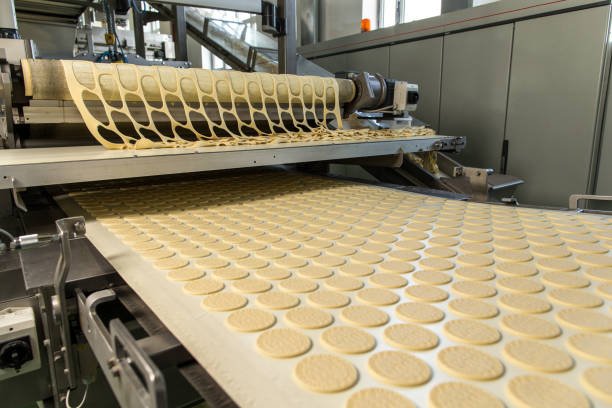
A rotary cutter forms individual biscuits from a continuous dough sheet. The prepared sheet travels between a cutting roll and a supporting conveyor or pressure roll. Depending on the product, the machine may cut the outline, create a surface pattern and add docking holes.
The final dimensions and weight of each dough piece depend on three main factors:
- The area enclosed by the cutting profile
- The thickness of the incoming dough sheet
- The density of the dough
The cutter controls the length and width of the piece, while the sheeting and gauging stages largely control its thickness. Dough preparation affects density and how the sheet responds to pressure.
A consistent cutter cannot produce uniform pieces when the incoming sheet has variable thickness or density. That is why effective rotary cutter troubleshooting should begin before the cutter itself.
Common Signs of Biscuit Shape and Weight Variation
Operators should watch for visible and measurable changes throughout the shift. Common warning signs include:
- Biscuits becoming longer or narrower
- Differences between the left and right sides of the line
- Uneven dough-piece thickness
- Incomplete cutting around the edges
- Biscuits remaining connected after cutting
- Distorted corners or decorative patterns
- Variation in docking-hole position
- Changes in dough-piece weight
- Excessive scrap around cut pieces
- Biscuits shifting during transfer
- Product rows entering the oven unevenly
- Baked biscuits having inconsistent colour or texture
Some problems appear immediately after the cutter, while others become more noticeable after baking. For example, a small variation in dough-piece thickness may result in a larger difference in final moisture or colour.
Practical Rotary Cutter Troubleshooting Sequence
When shape or weight begins to vary, adjustments should follow a logical order.
Step 1: Confirm the measurement
Check the scale, measuring device, sampling location and target specification.
Step 2: Inspect the dough
Review batch records, dough temperature, resting time, texture and consistency.
Step 3: Measure the incoming sheet
Check sheet thickness and width at several points before the cutter.
Step 4: Check dough-sheet tracking
Confirm that the sheet enters the cutter centrally without stretching, folding or moving sideways.
Step 5: Inspect cutter pressure
Verify that the pressure is sufficient and balanced across the working width.
Step 6: Inspect the cutting roll
Look for residue, damaged edges, blocked docking pins, wear or incorrect installation.
Step 7: Check conveyor condition
Confirm belt tracking, tension, cleanliness and speed.
Step 8: Verify speed synchronisation
Compare the sheeter, gauge-roll, cutter, discharge and scrap-removal speeds.
Step 9: Examine scrap separation
Check whether the scrap web is pulling or displacing cut pieces.
Step 10: Record the correction
Document the original condition, adjustment and result. This builds a useful troubleshooting history for future production.
How PMEPL Supports Consistent Rotary Cutting
Pragati Machinery and Engineering Private Limited manufactures biscuit-processing equipment for industrial production lines. Its Rotary Cutter can be integrated with dough-feeding, laminating, sheeting and industrial baking equipment according to the required product and production capacity.
For an accurate machine recommendation, manufacturers should provide:
- Biscuit samples or drawings
- Dough characteristics
- Target dough-piece weight
- Required sheet thickness
- Working width
- Production capacity
- Embossing and docking requirements
- Existing line details
- Available factory space
Providing complete production information helps the machinery manufacturer assess the cutter as part of the entire biscuit line rather than as an isolated unit.
Conclusion
Biscuit shape and weight variation during rotary cutting usually begins with an unstable process rather than a single machine defect. Inconsistent mixing, changing dough temperature, uneven feeding, incorrect gauge gaps and excessive dough stress can all affect the sheet before it reaches the cutter.
At the cutting stage, unequal pressure, worn cutting profiles, roll misalignment, belt problems and speed mismatch can further increase variation. Scrap removal and product transfer can also distort pieces after they have been formed.
Successful rotary cutter troubleshooting therefore requires a systematic approach. Begin with the dough, measure the incoming sheet, check the cutting conditions and then verify downstream transfer. Avoid making several adjustments at the same time, as this makes it difficult to identify the true cause.
With standardised dough preparation, accurate thickness control, balanced cutter settings and regular preventive maintenance, manufacturers can reduce uneven biscuit cutting and maintain more consistent shape, thickness and weight throughout industrial production.
Blogs
-
+ 91 9821048088
+91 9967474660 - pragati@pmepltd.com
- R-666, TTC Industrial Area, Rabale ,MIDC, Navi Mumbai -400701