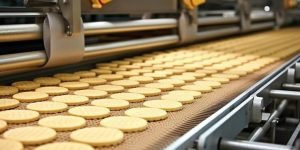

Pellet systems play an important role in modern food processing industries, especially in biscuit and snack production. These semi-processed food forms are designed for further processing, shaping, and cooking in industrial production lines.
According to international food processing standards, pellet systems help manufacturers achieve consistent product quality and production efficiency.
In large-scale manufacturing, pellet systems improve efficiency, maintain consistency, and enable flexible product development. They are widely used in snack production and certain biscuit processing applications.
With increasing demand for innovative food products, pellet systems are becoming an essential part of automated production lines.
What are Pellets in Food Processing?
Pellet systems are integrated production lines designed to create pre-formed food materials called pellets. These pellets are semi-processed forms that are later converted into final products through baking, frying, or expansion techniques.
Pellet systems are used for:
- Snack production (extruded and expanded snacks)
- Processed food manufacturing
- Specialized biscuit applications
- High-volume continuous production
A reliable pellet system ensures uniform pellet size, shape, and quality for consistent final products.
Key Components of Pellet Systems
1. Raw Material Preparation System
The process begins with preparing raw materials for pellet formation.
Machine used: Industrial Mixers
Function: Mixes ingredients uniformly for consistent pellet quality
2. Pellet Formation System
This is the core of pellet systems where pellets are created.
Machine used: Pellet Processing System
Function: Forms pellets into required shapes and sizes
3. Shaping and Cutting System
Pellets are cut into precise sizes for uniform processing.
Machine used: Cutting Systems
Function: Ensures uniform pellet size and shape
4. Forming System
Continuous shaping maintains production consistency.
Machine used: Die Roll System
Function: Maintains continuous shaping process
5. Drying or Conditioning System
Pellets are dried to achieve the right moisture content.
Function: Reduces moisture for stable storage and further processing
6. Final Processing System
Dried pellets are converted into final snack or biscuit products.
Machine used: Baking or Frying System
Function: Converts pellets into finished products
How Pellet Systems Work?
Pellet systems follow a structured and continuous process:
Step-by-Step Working Process:
1. Raw Material Preparation: Raw materials are mixed using Industrial Mixers to achieve uniform consistency.
2. Pellet Formation: The mixed material is processed through pellet formation equipment to create semi-processed pellets.
3. Cutting and Shaping: Pellets are cut to precise sizes using Cutting Systems for uniformity.
4. Drying or Conditioning: Pellets are dried to remove excess moisture and stabilize for storage.
5. Final Processing: Dried pellets are baked, fried, or expanded to create final snack or biscuit products.
6. Cooling and Packaging: Finished products are cooled and prepared for distribution.
This continuous process enables manufacturers to produce thousands of pellets per hour with consistent quality.
Features of Pellet Systems
A high-quality pellet system offers:
- Consistent pellet size and shape
- High production efficiency
- Suitable for continuous processing
- Flexible product applications
- Durable industrial design
- Stainless steel construction for hygiene
- Automated control systems
Proper dough preparation using Industrial Mixers ensures consistent pellet quality across all production stages.
A well-designed pellet system ensures smooth production and uniform output in food manufacturing.
Benefits of Pellet Systems
Choosing the rightpellet system offers:
- Improved production flexibility
- Consistent product quality
- Reduced material wastage
- High efficiency in processing
- Suitable for large-scale production
- Lower storage costs (pellets have longer shelf life)
- Quick changeover between product types
Uniform shaping can be achieved using Cutting Systems for precise product formation.
Investing in modern pellet systems enables manufacturers to produce multiple snack varieties on the same production line.
Pellet Processing System Overview
| Stage | System / Machine | Function |
|---|---|---|
| 1. Raw Material Preparation | Industrial Mixers | Mixes ingredients uniformly for pellet formation |
| 2. Pellet Formation | Pellet Processing System | Forms pellets into required shapes |
| 3. Shaping | Cutting Systems | Ensures uniform pellet size |
| 4. Forming | Die Roll System | Maintains continuous shaping process |
| 5. Processing | Baking / Frying System | Converts pellets into final product |
| 6. Final Output | Cooling & Packaging Systems | Prepares product for distribution |
Applications in Industry
Pellet systems are widely used in:
- Snack manufacturing industries
- Biscuit production plants
- Food processing industries
- Industrial bakery systems
- Export-oriented food production facilities
In some production lines, shaping is further refined using Die Roll Systems for uniform product output.
A reliable pellet system is essential for any industrial setup aiming for automation, efficiency, and product uniformity.
Complete Production Line Integration
In modern food processing, pellet systems must work in coordination with mixing, shaping, and baking systems to achieve efficient production. Proper integration ensures smooth workflow and consistent product quality.
To build an efficient production system, you can explore the following solutions:
Industrial Mixers – for uniform raw material preparation
Die Roll System – for continuous forming
Cutting Systems – for precise shaping
These machines help improve productivity, reduce downtime, and maintain consistent product quality. A well-integrated pellet system is the foundation of successful snack and biscuit production.
Conclusion
Pellet systems are an important component in modern biscuit and snack production. They offer flexibility, efficiency, and consistency in industrial food processing.
Pellet systems enable manufacturers to produce a wide range of products while maintaining high production standards. By integrating pellet systems with advanced machinery, manufacturers can achieve better productivity and consistent product quality.
For reliable pellet systems, working with an experienced supplier ensures long-term performance and technical support for your production line.
Contact a trusted pellet system manufacturer today to discuss your specific production requirements.
Blogs
-
+ 91 9821048088
+91 9967474660 - pragati@pmepltd.com
- R-666, TTC Industrial Area, Rabale ,MIDC, Navi Mumbai -400701